
Topiary facts for kids

Topiary is a special way of shaping plants. It's like making a living sculpture! Gardeners carefully trim trees, shrubs, and other plants. They cut the foliage (leaves) and twigs to create clear shapes. These shapes can be simple geometric forms or fun animals. The word "topiary" comes from a Latin word. It means a gardener who creates beautiful "places" or landscapes.
Plants chosen for topiary are usually evergreen. This means they keep their leaves all year. They often have small leaves and grow very densely. Some popular plants include boxwood (like Buxus sempervirens), arborvitae (Thuja), bay laurel, and yew (Taxus). Sometimes, gardeners use wire frames to help guide the plant's growth. But traditional topiary needs a lot of patience and skill. A simple hedge is also a type of topiary. It creates natural walls or boundaries in a garden.
Contents
The History of Topiary
Ancient Beginnings: Roman Gardens

Topiary has a long history, going back to Ancient Rome. People believe that a man named Gaius Matius Calvinus first brought topiary to Roman gardens. This was around the time of Julius Caesar. Writers like Pliny the Younger described amazing topiary shapes. These included animals, letters, and tall obelisks made from trimmed plants. Roman gardeners used topiary to create miniature landscapes in their homes and villas.
Far Eastern Topiary Styles

In China and Japan, people also shaped trees and shrubs. But their reasons were a bit different. They wanted to show the natural beauty of old trees. They aimed to highlight how wind and weather had shaped them. This art is seen in Chinese penjing and Japanese bonsai, which are miniature trees.
Japanese cloud-pruning is similar to European topiary. It creates cloud-like shapes that look especially pretty after snow. Japanese Zen gardens also use Karikomi. This is a technique where shrubs are clipped into large, curved shapes. They also use Hako-zukuri, which means clipping shrubs into boxes and straight lines.
Topiary in the Renaissance


During the Italian Renaissance, gardens became very popular. They focused on perfect balance and patterns. Knot gardens were a new trend. These were made from crisscrossing hedges and fragrant herbs. They often had square, symmetrical designs. These designs were inspired by patterns found on carpets or embroidery.
Later, the parterre developed from knot gardens. Parterres featured trimmed shrubs and statues arranged in geometric patterns. These became a main part of formal European gardens. French designers, like André Le Nôtre at Versailles, made these gardens even grander. Dutch gardeners were known for their detailed designs. Topiary could be found in large estates and smaller cottage gardens.
A Dip in Popularity

In the 1700s, topiary became less fashionable in England. A writer named Alexander Pope even made fun of it. He wrote a funny essay describing silly topiary shapes. For example, he joked about "Adam and Eve in yew" or a "quickset hog, shot up into a porcupine."
Because of this, many grand English gardens removed their hedges and topiary. However, topiary continued to be loved in cottage gardens. People would pass down a special topiary plant, like a ball or a cone-shaped tree, through generations. A famous example is the ancient yew tree at Harlington, London. It was once shaped like an obelisk with a ball on top. Today, it still stands, though it hasn't been trimmed in a long time.
Topiary Makes a Comeback
The Victorian Revival

In the 1800s, topiary started to become popular again in England. People began to miss the shaped gardens that had been removed. Elvaston Castle in Derbyshire opened its gardens to the public in the 1850s. Its amazing topiary displays caused a sensation! Soon, architectural topiary (like shaped walls and structures) appeared everywhere. Later, sculptural topiary (like animal shapes) also became popular.
Writers like James Shirley Hibberd helped bring back the charm of topiary. It became a key part of the "English cottage garden" style. This style mixed formal elements with more natural plantings. The idea was that while a tree's natural form is beautiful, sometimes we want to create our own designs.
Arts and Crafts Gardens
The British Arts and Crafts movement also embraced topiary. This style focused on traditional craftsmanship. A book called Topiary: Garden Craftsmanship in Yew and Box by Nathaniel Lloyd was very important. Lloyd's own home, Great Dixter, became a famous example. It showed how topiary could blend with "cottagey" plants like roses. Garden designers like Gertrude Jekyll and Edwin Lutyens used this mix in their work.
Topiary in America
Americans also became interested in topiary. When William Waldorf Astor bought Hever Castle in England around 1906, he added a large "Old English Garden." This garden featured impressive hedges and topiary shapes. In America, topiary became popular in Colonial Revival gardens. These gardens recreated styles from early American history. For example, the topiary maze at Colonial Williamsburg was replanted in the 1930s.
Modern Topiary: The 20th Century and Beyond
Disney's Influence

In the 1960s, Disneyland introduced a new kind of topiary. Walt Disney wanted to bring his cartoon characters to life in the park's gardens. This led to "portable topiary." It uses a steel wire frame shaped like a character. Plants grow through and around this frame. The frame stays inside, guiding the plant as it fills out the shape.
This method created amazing displays at Disney parks. It also led to mosaiculture. This is an art form where many different plants create a living mosaic or sculpture. A famous example was at the 2008 Summer Olympics in China. Today, you can see living company logos and green walls that clean the air, all inspired by this technology.
Artificial Topiary
Sometimes, people use artificial topiary. These are fake plants shaped like real topiary. They are often used indoors for decoration. They look like living topiary but don't need watering or trimming.
Amazing Topiary Displays Around the World
-
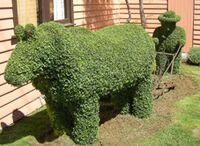
Topiary at Railton, Town of Topiary, Tasmania, Australia
-
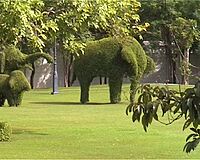
Topiary elephants at Bang Pa-In Royal Palace, Thailand
-
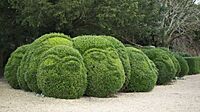
Topiary at Kingston Lacy, Dorset, England
-
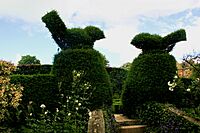
Topiary birds at Hidcote Manor Garden, Gloucestershire, England
-
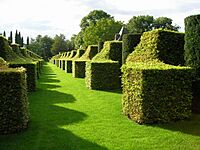
Topiary garden at Manor d'Eyrignac, France
-
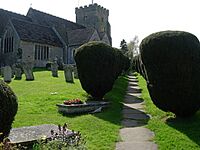
The path to St Peter's Church in Henfield, West Sussex, England
-
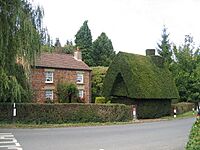
Topiary house in Longhope, Gloucestershire, England
-
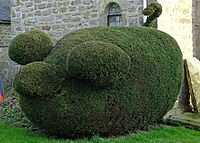
A topiary pig in Halton, Northumberland, England
-
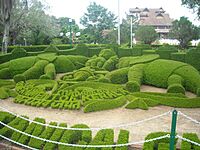
Topiary in the Botanical garden Thiruvananthapuram, India
-
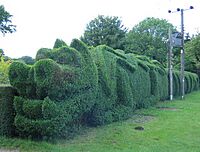
Dragon shaped hedge, East Rudham, Norfolk, England


.jpg)


Australia
- Railton, Tasmania: This town is known as the "Town of Topiary" because of its many shaped plants.
Asia
- Mosaiculture 2006 (Shanghai, China): A huge display of living plant sculptures.
- The Samban-Lei Sekpil in Manipur, India: This is the world's tallest topiary! It measures over 18 meters (60 feet) high. It's shaped from a shrub called Duranta erecta.
- Bang Pa-In Royal Palace in Thailand: Features beautiful topiary elephants.
- The Terrace Garden in Chandigarh, India: Has fun animal topiaries for children to enjoy.
Central America
- Parque Francisco Alvarado, Zarcero, Costa Rica: Famous for its intricate topiary designs.
South America
- Tulcan Topiary Garden Cemetery, Tulcan, Ecuador: A unique cemetery with many impressive topiary sculptures.
Europe
- Cliveden (Buckinghamshire, England)
- Levens Hall (Cumbria, England): This garden has the oldest topiary in the world! It was started in the late 1600s.
- Topsham railway station (Devon, England): Features topiary lettering.
- Canons Ashby (Northamptonshire, England): A historic garden with topiary.
- Stiffkey, (Norfolk, England): Look for a line of topiary elephants at Nellie's cottage!
- Hidcote Manor Garden (Gloucestershire, England)
- Knightshayes Court (Devon, England)
- Owlpen Manor (Gloucestershire, England)
- Great Dixter Gardens (East Sussex, England): A famous garden known for its mix of topiary and other plants.
- Much Wenlock Priory, Shropshire
- Drummond Castle Gardens (Perthshire, Scotland)
- Portmeirion (Snowdonia, Wales)
- Parc des Topiares (Durbuy, Belgium): A large garden with over 250 topiary figures.
- Château de Villandry, France
- Villa Lante (Bagnaia, Italy)
- Giardino Giusti (Verona, Italy)
- Castello Balduino (Montalto Pavese, Italy)
- Guggenheim Museum Bilbao (Bilbao, Spain): Home to a giant topiary sculpture of a West Highland White Terrier dog by artist Jeff Koons.
- The Tsubo-en Zen garden in Lelystad, Netherlands: A modern Japanese Zen garden with cloud-pruning and box-shaped topiaries.

- Gardens of the Palace of Versailles outside Paris, France
North America
- Hunnewell Arboretum (Wellesley, Massachusetts): Features a 140-year-old topiary garden.
- Ladew Topiary Gardens (Monkton, Maryland): Famous for its "hunt" scene topiary, with horses, riders, and a fox jumping over a hedge.
- Topiary Garden at Longwood Gardens (Kennett Square, Pennsylvania)
- Columbus Topiary Park at Old Deaf School (Topiary Park, Columbus, Ohio): This public garden recreates a famous painting by Georges Seurat using topiary!
- Pearl Fryar's Topiary Garden, (Bishopville, South Carolina)
- Green Animals, (Portsmouth, Rhode Island): One of the oldest topiary gardens in America.
- Busch Gardens Tampa, established 1959: This park has many large and colorful topiary sculptures.
See also
 In Spanish: Topiaria para niños
- Bibliography of hedges and topiary
- History of gardening
- Tree shaping
